
Zero Trust Connectivity for Physical Devices & Edge AI
SASE-built security with the SIM as your hardware root of trust.
Authenticate devices using hardware-grade security with the SIM card as your trusted root. Monogoto separates user data from authentication to achieve true Zero Trust architecture.

Hardware Root of Trust
SASE Architecture by Design
Separated Authentication & Data Planes
HSM-Grade Cryptographic Security
Edge AI & Physical Device Ready
Global Connectivity with Zero Trust Principles
What is Zero Trust for Physical Devices?
The next wave of connected devices isn’t IoT, it’s physical devices and Edge AI. Autonomous vehicles, delivery robots, industrial machinery, and AI-powered edge systems require a fundamentally different security approach. Traditional perimeter-based security fails when devices operate at the edge, often in hostile environments, with intermittent connectivity.
Zero Trust connectivity assumes no device or network is inherently trustworthy. Every connection must be verified. Every device must prove its identity. With Monogoto, the SIM card becomes your hardware root of trust, a tamper-resistant element that authenticates your device to the network using cryptographic credentials that never leave the secure element.
What Zscaler and Cato Networks did for enterprise MPLS, Monogoto does for physical devices and Edge AI; replacing fragmented, vulnerable connectivity with unified, secure, cloud-native architecture.
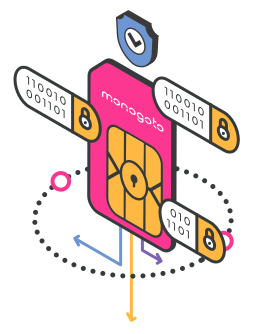

SASE by Design: Separation of Data and Authentication
Secure Access Service Edge (SASE) converges networking and security into a unified, cloud-delivered service. Monogoto is SASE by design because we fundamentally separate the user data plane from the authentication plane.
How it works:
- Authentication via SIM HSM: Your device authenticates using the Hardware Security Module (HSM) embedded in the SIM card. This dedicated application cannot access the internet, it only communicates with our secure core through encrypted cellular signaling.
- Isolated Data Plane: After authentication, user data flows through a separate, policy-controlled path. Your device’s data traffic is completely isolated from authentication credentials.
- Continuous Verification: Unlike VPNs that grant broad access after initial login, Monogoto continuously verifies device identity and enforces least-privilege access policies throughout the session.
This architecture eliminates the attack vectors that plague traditional IoT connectivity. Even if user data is intercepted, authentication credentials remain protected in the hardware secure element.
Hardware Root of Trust, The SIM as HSM
The Monogoto SIM card acts as a Hardware Security Module (HSM), a tamper-resistant cryptographic processor that protects keys and performs secure operations. Unlike software-based security that can be compromised by malware, HSM-grade security ensures:
- Cryptographic keys never leave the secure element
- Authentication occurs in isolated, tamper-proof hardware
- Devices authenticate even in disconnected or hostile environments
- Physical device compromise doesn’t expose network credentials
For Edge AI applications, from autonomous robots to smart industrial equipment, this means your device identity is protected by the same security principles used in banking and government applications


Built for Physical Devices & Edge AI
Physical devices operating at the edge face unique challenges: intermittent connectivity, physical access by bad actors, limited resources for security software, and the need for autonomous operation. Monogoto Zero Trust connectivity is purpose-built for these requirements:
- Autonomous Vehicles & Robotics: Authenticate vehicles and robots with hardware-grade security, even when transitioning between networks or operating in contested environments.
- Industrial Edge AI: Secure AI inference devices and industrial automation with Zero Trust principles, protecting intellectual property and operational data.
- Critical Infrastructure: Smart meters, grid sensors, and utility devices benefit from network-level security that doesn’t depend on device-side software patches.
- Fleet & Logistics: Manage thousands of connected assets with centralized policy control and real-time visibility across global deployments.
Global Coverage, Single SIM, Zero Trust
Deploy your physical devices anywhere with a single SIM that provides access to 550+ networks in 200+ countries. Zero Trust security travels with your device:
- Consistent security policies enforced globally
- Remote SIM profile management without physical access
- Multi-IMSI support with eUICC/eSIM for maximum resilience
- Self-service platform for complete visibility and control
- API access for integration with your security operations

Frequently Asked Questions
Zero Trust connectivity is a security approach that assumes no device, user, or application should be trusted by default. Every connection request must be authenticated, authorized, and continuously verified before access is granted.
For IoT deployments, Zero Trust helps ensure that connected devices can only communicate with approved networks, applications, and services, reducing the risk of unauthorized access and cyberattacks.
Zero Trust for IoT starts with strong device identity. Each device is authenticated before it can access network resources, and communications are restricted based on predefined security policies.
Instead of allowing broad network access, Zero Trust limits devices to only the applications, services, and endpoints required for their specific function. This minimizes exposure and helps prevent unauthorized lateral movement across networks.
IoT devices are often deployed in remote locations, operate for years in the field, and may connect across multiple networks and geographies. Traditional perimeter-based security models are difficult to maintain at scale.
Zero Trust security helps reduce risk by verifying device identity, limiting access permissions, and restricting communications to only approved resources. This approach helps contain potential threats and improves the overall security posture of connected device deployments.
SIM-based authentication uses the SIM, eSIM, or iSIM as a hardware-based root of trust for connected devices. Because device credentials are securely stored within the SIM, authentication occurs at the network level before traffic reaches applications or cloud services.
This approach provides a strong foundation for IoT security and helps verify that only authorized devices can connect to network resources.
A traditional VPN creates a secure tunnel between devices and a network, but once connected, devices may have broad access to network resources.
Zero Trust takes a more granular approach by continuously verifying identity and enforcing access controls at the device, application, and network levels. Rather than granting blanket access, Zero Trust limits each device to only the resources it is authorized to use.
No. Because enforcement happens at the network level using the SIM as the root of trust, Zero Trust policies (device authentication, IMEI lock, signaling and data firewalls, and traffic restrictions) apply even to constrained devices that cannot run security agents. This makes Zero Trust practical for IoT fleets where installing and maintaining endpoint software is not feasible.
Zero Trust policies can be applied consistently across devices regardless of location, network, or carrier. This enables organizations to maintain a unified security posture as devices move between countries, mobile operators, private networks, and satellite networks.
By combining device identity, policy enforcement, and secure connectivity, organizations can scale IoT deployments globally without sacrificing security or operational visibility.
A private APN (Access Point Name) creates a dedicated pathway between connected devices and authorized applications, keeping device traffic separate from the public internet.
Private APNs are commonly used in industries such as healthcare, financial services, logistics, and critical infrastructure to improve security, reduce exposure to threats, and maintain greater control over device communications.