IoT Connectivity
Simple. Global. Secure.
Global cellular connectivity for IoT and M2M devices with full control and best-in-class security.
Easy, Cost-effective Set up
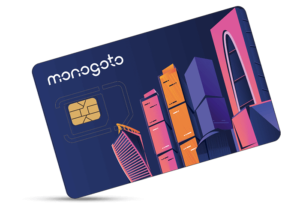
Connect your devices anywhere with Monogoto IoT SIM cards and gain access to our global cellular network. Manage and control your IoT network with a superior set of features without the need for cellular expertise. Monogoto IoT SIM cards are designed with developers in mind because our mission is to simplify your IoT connectivity and day-to-day work.
The days of multiple SIM vendors in multiple countries are gone. Instead, Monogoto provides a single SIM that gives you access to our secure cloud-based cellular network with global reach and no service provider lock-in.
Single IoT SIM with Global Reach
With Monogoto’s plug and play IoT SIM cards you’ll be up and running fast with immediate global connectivity and maximum network resiliency in 200+ countries on 550+ mobile networks.
You can connect with a variety of cellular technologies, from legacy 2G and 3G networks to 4G LTE networks.
Advanced power saving technologies such as Extended Discontinuous Reception (eDRX) and Power Saving Mode (PSM) are integrated and controlled via the Monogoto APIs to minimize battery consumption and reduce costs.
Be your own roaming manager and enable your devices on selected networks using Monogoto’s easy-to-use self-service platform.
Full Visibility with Built-in Security
Get full network visibility and real-time anomaly detection on any network event. It’s as if you are the mobile operator yourself.
Create your own set of policy rules related to IP or signaling traffic for a single or group of SIMs by using our network-based signaling, SMS, DATA firewall, MITM prevention, and anomaly detection tools.
Automate alerts to harden your network security.
Unified Technology, Unified Fit
Monogoto’s “as-a-service” connectivity technologies fit any project size with a wide selection of features and capabilities.
Monogoto’s solution is a perfect fit for:
- Large enterprises with multi-zone, secure, and controllable connections
- Service integrators who are looking for reliable and flexible technology
- Resellers that manage multiple accounts and are looking for ways to monetize their value
- IoT startups who need to start small with the ability to scale fast as they grow
- Developers who are looking for specific APIs, extra debug and visibility tools as they prototype their next IoT product.
Setup Your Global IoT Connectivity Today.
IoT Connectivity - Main Building Blocks
IoT SIM Cards
We offer a range of SIM cards to fit any IoT device. Regular (UICC), Embedded (eUICC) and Integrated (iUICC) SIM card form factors.
Connectivity Management Platform
A superior self-service connectivity platform to ease your daily management, control, and security tasks.
Secure Mobile Core
Offload your network security needs to the Monogoto network and protect your devices from external threats and vulnerabilities.
Tailor-made offerings
SIM lifecycle management
Network management
Anomaly detection
Alerts Based on network events
Dashboard and reports
Personal security
Roaming control
Business operation
Signalling and IP firewalls
SIM lifecycle management
Network management
Dashboard and reports
Global roaming control
Business operation
Personal security
Signalling and IP firewalls
Alerts Based on network events
Anomaly detection
API’s and web-hooks
Tailor made offering
And more…
Get in Touch With Our Experts Today
Use Cases
From smart streetlights to vehicle telematics, electric scooters and more.
Whatever the size and whatever the stage of your IoT project, Monogoto’s global IoT cellular cloud services provide resilient and secure cellular connectivity, full network control and visibility, rapid time-to-market and cost-effective solutions which are designed to scale.
Street Lights
Fleet Management
Smart Metering
Clean Energy
Waste Management
Asset Tracking
Check Out Our Global Coverage List
Check Out Our Global Coverage List (Download List)
Frequently Asked Questions
IoT connectivity enables devices, sensors, vehicles, and equipment to securely transmit data between the physical world and cloud applications. It provides the communication layer that powers asset tracking, fleet management, remote monitoring, smart infrastructure, healthcare devices, industrial automation, and countless other IoT applications.
Reliable connectivity is essential for collecting data, managing devices remotely, and maintaining visibility across connected operations.
IoT devices use embedded SIMs, eSIMs, iSIMs, or cellular modules to connect to mobile networks and transmit data. Once connected, information can be securely routed to cloud platforms, business applications, or operational systems for monitoring, analytics, and automation.
Modern IoT connectivity platforms also provide centralized tools for managing devices, connectivity policies, security settings, and network usage.
The best connectivity technology depends on the application’s requirements.
- LTE-M is ideal for mobile devices, wearables, healthcare, and asset tracking.
- NB-IoT offers deep radio coverage for stationary devices such as meters and sensors, though operator support varies by region and several carriers are phasing it out. (See: Should I rely on NB-IoT only?)
- LTE Cat-1 supports higher throughput applications, including telematics and payment terminals.
- 5G is designed for high-bandwidth, low-latency use cases such as video, robotics, and advanced industrial automation.
- Satellite (NB-IoT NTN) is ideal for remote or off-grid assets such as cattle monitoring or off-shore communications.
Many organizations deploy multiple connectivity technologies within the same IoT environment.
Large-scale IoT deployments are typically managed through a centralized connectivity management platform. These platforms provide visibility into device status, SIM lifecycle management, usage monitoring, policy automation, diagnostics, and reporting.
Centralized management helps organizations efficiently scale from pilot projects to thousands or millions of connected devices.
IoT connectivity security typically starts with device authentication using SIM, eSIM, or iSIM credentials. Additional security measures may include private APNs, encrypted communications, network access controls, traffic monitoring, and Zero Trust security architectures.
These technologies help organizations protect connected devices, data, and applications throughout the device lifecycle.
In most cases, no. While NB-IoT has its strengths, we generally don’t recommend building a deployment on NB-IoT alone, for three reasons.
First, carrier support is shrinking. Several operators are sunsetting NB-IoT(AT&T, for example, has stopped NB-IoT sales and is decommissioning its network, migrating customers to LTE-M). Betting a multi-year device deployment on a technology that operators are phasing out creates real lifecycle risk.
Second, NB-IoT roaming support is limited. Unlike LTE-M and LTE Cat-1, NB-IoT roaming agreements between operators remain patchy, which complicates international and multi-region deployments.
Third, the power advantage is often overstated. NB-IoT is assumed to always be cheaper on power, but its very low data rates mean each transmission takes longer, so depending on payload size and reporting frequency, LTE-M can be the same if not better. Where NB-IoT does shine is radio reception: its deep coverage helps in basements, underground, and dense environments.
Our recommendation: design around LTE-M (or LTE Cat-1) with multi-mode modules, and treat terrestrial NB-IoT as a fallback where coverage requires it rather than as a foundation. The notable exception is satellite: NB-IoT over NTN is one of the most promising uses of the technology.

Satellite IoT connectivity allows devices to transmit data via satellite networks, extending coverage far beyond the reach of terrestrial cellular. With 3GPP-standardized Non-Terrestrial Networks (NTN), standard cellular chipsets can now communicate directly with satellites, no proprietary satellite hardware required.
Monogoto integrates satellite connectivity into the same SIM, platform, and policies as cellular, so devices can use terrestrial networks where available and fall back to satellite where they aren’t.
Satellite is ideal wherever cellular coverage is unavailable or unreliable: remote agriculture, mining, energy and utilities infrastructure, maritime and offshore assets, and long-haul logistics crossing coverage gaps. It’s also increasingly used as a resilience layer, a backup path that keeps critical devices reporting when terrestrial networks fail.
Most deployments use satellite as part of a hybrid strategy, combining cellular for day-to-day traffic with satellite for coverage gaps and continuity.
While we’re cautious about relying on terrestrial NB-IoT, satellite is where the technology genuinely shines. NB-IoT’s narrowband waveform and tolerance for delay make it well suited to the long link distances and constrained link budgets of satellite communication, and it was standardized for NTN in 3GPP Release 17.
In practice, this means low-cost, low-power cellular IoT devices can send small payloads directly via satellite using standard chipsets. Monogoto offers NB-IoT NTN satellite connectivity through its integration with Skylo, managed through the same SIM and platform as terrestrial connectivity.
Modern eSIM and remote SIM provisioning technologies allow organizations to update connectivity profiles over the air without physically replacing SIM cards. This provides greater flexibility throughout the device lifecycle and helps organizations adapt to changing coverage, pricing, and business requirements.
When evaluating an IoT connectivity provider, organizations should consider network coverage, multi-carrier support, security capabilities, device management tools, global deployment support, scalability, pricing transparency, and access to technologies such as eSIM, private wireless, and satellite connectivity.