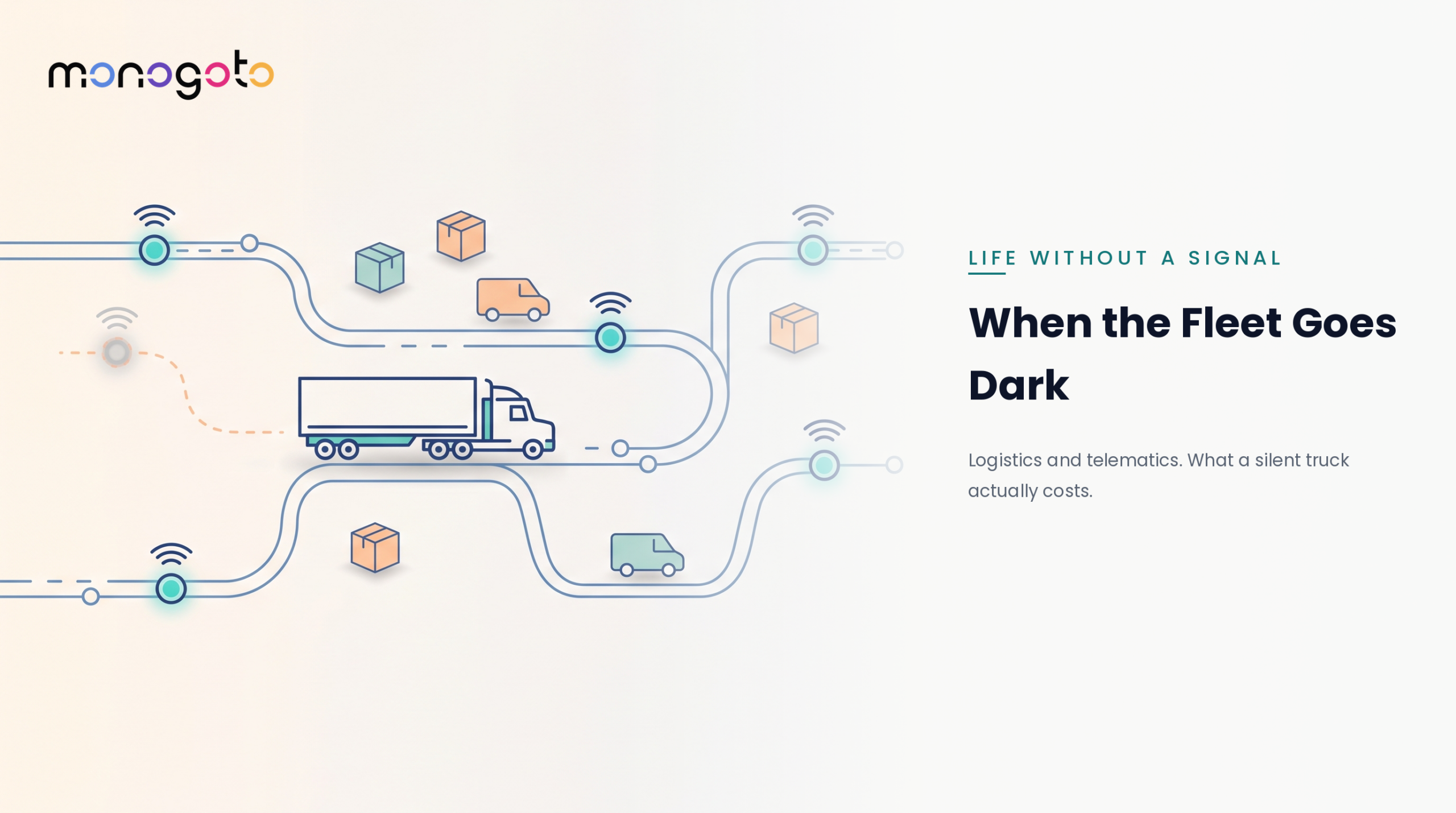

Logistics and telematics. What a silent truck actually costs.
It’s 2:17 a.m. on a Tuesday, and a refrigerated trailer is somewhere on I-80 in western Nebraska.
The tracker on it last reported at 1:04. Nobody knows that yet, because nothing in the system is designed to announce an absence. The dashboard shows the last known position, and it looks exactly like the current position until someone checks the timestamp.
At 6:30 a.m., a dispatcher notices the truck hasn’t moved on the map in five hours. It has, in fact, moved 280 miles. What hasn’t moved is the data.
By the time anyone establishes what happened, the shift has turned over twice, a customer has called about a delivery window, and a driver has spent forty minutes on the phone confirming things the device was installed to report automatically.
Coverage existed along the route. The tracker just couldn’t use the available network.
Why fleet trackers go offline even when coverage exists
Here’s what usually happens, and none of it appears on a coverage map.
The device is provisioned on one carrier. Overnight, that carrier made a routine change on the network: a configuration push, a capacity rebalance, a band reallocation in a rural market where nobody complains. The device didn’t fail. It attached, sat on a network that had stopped carrying its traffic properly, and kept trying. It never dropped hard enough to trigger an alarm and never worked well enough to send anything.
Second possibility: a roaming agreement changed. Trucks cross state lines and, increasingly, borders. The roaming relationships underneath them are commercial agreements that get renegotiated, expire, or get quietly deprioritized. No one tells the fleet operator because in the carrier’s model, the fleet operator isn’t the party to that agreement.
Third possibility, and the most common one nobody looks for: the device was fine, the network was fine, and the fleet had no way to tell the difference between a truck that’s parked and a truck that’s stopped reporting. Silence and stillness look identical on a map.
The mechanism matters less than the shape it has in common. In all three cases, the signal was present. In all three cases, the failure was invisible for hours. And in all three cases, the fix required a human to notice something that no system was watching for.
What a silent truck actually costs
The cost of a connectivity failure isn’t the megabytes that didn’t move. It’s everything that happens because they didn’t.
- A truck roll to inspect a device that turns out to be working means a technician, a vehicle, and hours of unnecessary field time.
- A driver manually confirming location or delivery status is paid labor that replaces a process the business has already automated.
- A missed delivery window can mean a service credit, SLA penalty, or unhappy customer.
- A gap in hours-of-service, temperature, emissions, or other required records can become a compliance exposure rather than a connectivity inconvenience.
- A dispatcher chasing down a “missing” vehicle is spending time solving a data problem instead of running the fleet.
None of those costs show up on the connectivity invoice. All of them show up somewhere.
And that’s one of the strange economics of fleet connectivity: the connectivity line item can stay green while the operational cost of connectivity failure keeps climbing.
Two patterns from our own network are worth sitting with. First, across the vehicle and asset-tracking deployments, we see monthly data consumption per device spans roughly four orders of magnitude, from fractions of a megabyte on low-power asset tags to well over two gigabytes on video-equipped fleets. That range exists inside the single category called “fleet.” Any connectivity product priced and configured as though fleets are one thing is wrong about most of them.
Second, and even more uncomfortable: we can detect fleets in which a meaningful population of SIMs has gone completely silent, zero bytes, not low bytes, and remained that way. Devices still on the bill, still nominally deployed, no longer talking to anything. Nobody chose that. Nobody noticed either.
Why the traditional approach can’t fix this
Because the traditional approach was designed for a different problem.
A single-carrier SIM makes an assumption: that the network you chose at procurement will be the right network for the life of the device. For a phone on a two-year contract in a city, that’s roughly true. For a tracker bolted to a trailer that will run for eight years across a dozen markets, it isn’t remotely true, and the device has no way to act on the difference.
The physical constraint is sharper than most teams realize until it bites. Take Bransys, which builds fleet and asset-tracking hardware for transportation, construction, mining and waste operators. Their devices read vehicle telematics through the OBD-II port, with battery-powered units for assets without a wired connection, and the SIMs are soldered directly onto the devices’ circuit board.
That’s good engineering. Soldered SIMs survive vibration, temperature, tampering, and a decade in a wheel well, which is exactly what heavy equipment demands. But it also means there is no field fix. You cannot send someone to swap a SIM in 4,000 machines spread across four industries. Whatever the connectivity decides to do, you live with it, unless the connectivity itself can change without anyone touching the hardware.
That’s the actual requirement, and it’s two things, not one.
The device needs somewhere else to go. Not a fallback you activate by opening a ticket, but multiple operator identities on the same SIM, with steering that moves traffic when a network degrades rather than when a human diagnoses it. If a carrier makes an overnight change, the device should have somewhere else to go before anyone notices there was a problem.
The fleet needs to know when a device goes silent. Not uptime dashboards, which measure whether the network is up. The question is whether this device sent what it was supposed to send, when it was supposed to send it, and whether the pattern changed. A device that has gone quiet is a detectable event. It just has to be something you’re looking for.
Every tracker has a pattern. When that pattern suddenly disappears, the absence itself should become an event.
For fleet connectivity, resilience ultimately comes down to those two capabilities: somewhere else for the device to go, and a way to know when it needs to.
What resilient fleet operators do differently
The operators who don’t have this problem mostly didn’t buy their way out of it. They changed four habits, and none of the four requires a procurement cycle.
They design for network change. In fleet hardware, the SIM is frequently soldered, potted, or sealed behind an enclosure rated for a decade of vibration. That makes the connectivity decision as permanent as the housing, and it gets made at the bill-of-materials stage, often by an engineer optimizing for unit cost, months before anyone in operations sees it. The good ones put an operations person in that review.
They monitor silence. Every device class has an expected reporting cadence. The resilient operators write the cadence down and alert when a device misses it, because a device that has stopped sending will never send an error saying so. This is the single highest-value change available, and it’s a configuration decision, not a purchase.
They reconcile deployed assets with connected assets. Active SIMs versus active assets. The gap is always larger than expected, and it’s where the silent-device population hides. It’s an afternoon of work, and it usually pays for itself the first time.
They exercise the fallback. Whatever redundancy exists, a second network, a store-and-forward buffer, or a manual process gets exercised deliberately rather than discovered during an incident. Untested resilience is a belief, not a capability.
The leadership lesson across all four is easy to miss: these failures rarely appear as connectivity failures. They surface as driver hours. Dispatcher time. Service credits. Missed deliveries. Field service. Compliance gaps. Customer complaints.
The question to take to your team
Not “do we have coverage.” You have coverage. Ask this instead:
“If a tracker went silent right now, how long would it take us to know, and would we know why, or only that it happened?”
If the answer involves a customer calling, a dispatcher checking a timestamp, or someone opening a carrier ticket and waiting, the problem isn’t simply coverage.
It’s that your fleet can disappear from view while everything still looks connected.
And by the time you notice, the signal may be the least expensive thing you’ve lost.
New editions released every other week; stay tuned.