

What was once an expensive and complex field reserved for rocket scientists backed by corporate funds, is now something developers can prototype over a weekend. The barrier to implement Satellite IoT into one’s use case is lowering rapidly. This shift is driven by new standards, maturing hardware, and platform integration that abstracts away much of the complexity. Here’s where Satellite IoT (or NTN, Non-Terrestrial Networks) stands today.
In our recent webinar Hands-on with Satellite IoT, we showcased a live end-to-end demo of sending data from a $100 device directly to a satellite.
Direct-to-Satellite Connectivity
Until recently, satellite communication required specialized hubs or gateways to relay data to satellites. That’s no longer the case. With the advent of 3GPP Release 17, devices can now connect directly to satellites using standard modules, without any specialized satellite-grade hardware or antennas.
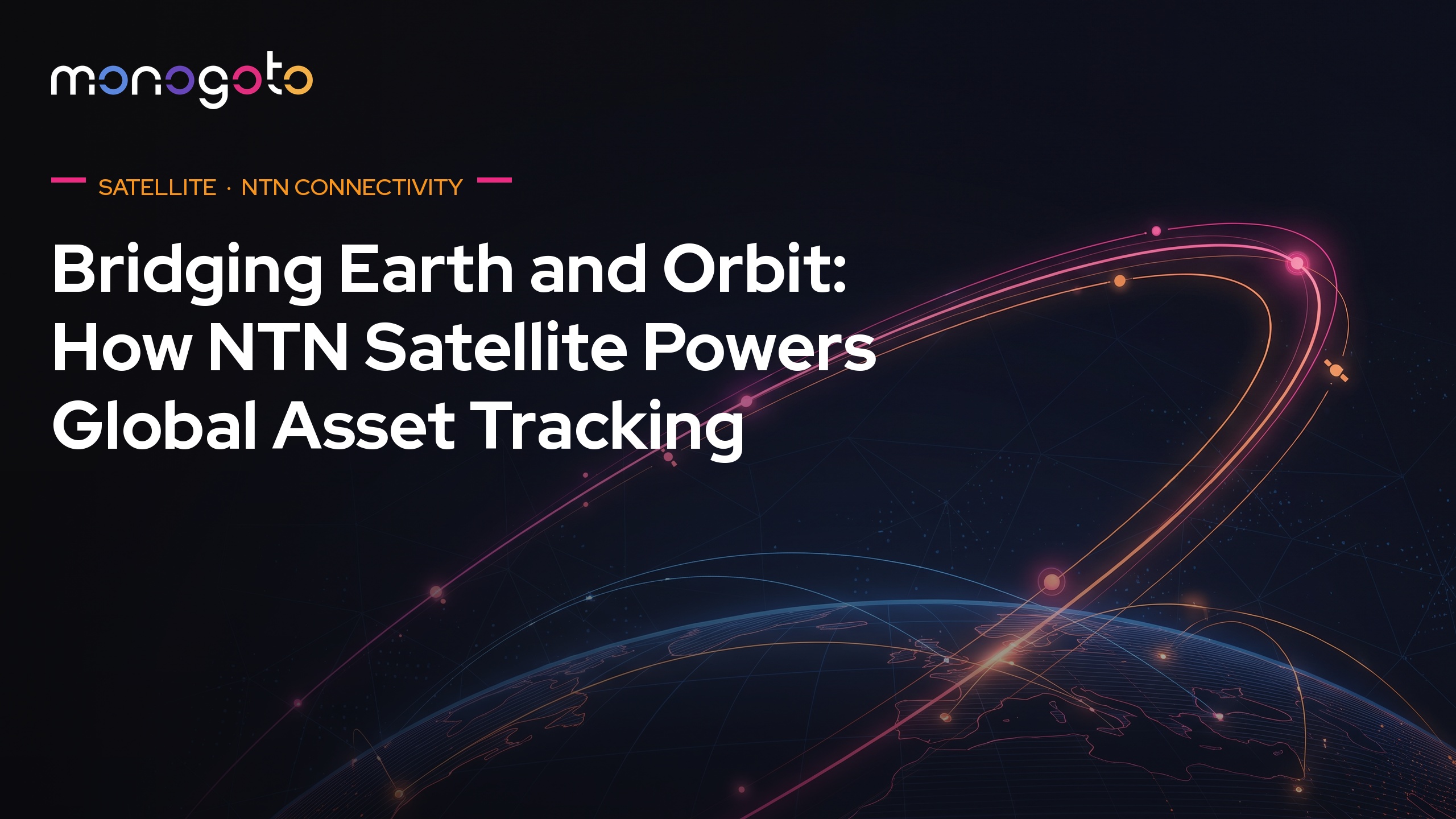
This is enabled in part by geostationary satellites (GEO), like those used by Skylo, orbiting at around 22 thousand miles (36 thousand km) altitude. Despite the distance, small IoT devices with normal NB-IoT antennas can transmit data using little power due to efficient NB-IoT modulation and high-gain antennas on satellites. Skylo’s network is already live across large parts of North and South America, Europe, Australia, and beyond.
“We support about 20 packets per minute, each up to 1200 bytes. We’ve observed latency of 5 to 10 seconds for a message to travel to the satellite and back to Earth.”
— Steven Mitchell, Skylo
While LEO (Low Earth Orbit) satellite companies like Sateliot, OQ Technology, and Iridium are also making headlines, GEO provides unmatched coverage (for now) as it requires far fewer satellites to cover the globe compared to LEO constellations which operate at a few hundred kilometer altitude.
Hardware Accessibility
What used to be a major barrier — specialized satellite modems — is dissolving quickly. Murata’s latest Type 1SC module, based on the Sony Altair chipset, now supports both terrestrial NB-IoT and satellite NTN. It’s pin-compatible with earlier cellular modules, requires no special antennas, and fits in a 11.1 x 11.4 mm package.
“You can use both terrestrial and non-terrestrial communication just by this one module. If you are already using our Type 1SC module for cellular communication you can add NTN by just replacing the module with this latest 1SC-NTN version. You don’t have to change any other part of your design.”
— Hiro Hyogo, Murata
Notably, it’s priced only slightly higher than traditional NB-IoT modules, making satellite IoT accessible for budget-conscious projects.
Dev kits are already available, and more chipmakers are expected to follow suit, further lowering entry barriers.
Native Monogoto Integration
A significant shift in Satellite IoT is how easy it is to integrate. Monogoto already embedded satellite NTN into their global cellular platform. This means that no extra SIM is required, the IP address stays the same whether using terrestrial or non-terrestrial networks, and the cloud endpoints and APIs are similar.
“Whether your device connects via AT&T, private LTE, or satellite — the IP doesn’t change. Your app doesn’t care.”
— Maor Efrati, Monogoto
Monogoto provides a web portal and API access where users can monitor both terrestrial and satellite traffic in one place, and their VPN feature reduces protocol overhead, helping developers reduce message size while improving the security posture of their applications.
Restrictions and Practicalities
While the promise of Satellite IoT is compelling, it’s not without tradeoffs:
- NB-IoT only: Currently, satellite NTN supports NB-IoT, not LTE-M or Cat-1.
- UDP-only: Traffic must be sent as UDP, no TCP.
- Line of sight: Devices need a clear view of the sky, don’t expect indoor or underground coverage.
- Payload constraints: Typical limit of packet size is ~1,200 bytes.
- Latency: GEO satellites add ~5–10 seconds of delay.
- Data costs are significantly higher: $0.30 per kB (instead of $0.01 per MB using T-Mobile).
Conclusion: Satellite IoT Is No Longer Out of Reach
Satellite IoT is no longer reserved for deep-tech companies or defense contractors. With commercial hardware, developer-friendly tools, and consumption-based pricing, it’s now within reach of any developer.
Whether you’re building agriculture sensors, asset trackers, or remote infrastructure monitoring, NTN lets your devices stay connected beyond the grid, often with the same code and hardware you already use.
Want to try it yourself? For $100, you can get a dev kit that connects directly to satellites, with no special setup required. Order the Satellite IoT Extension Kit today.